Allen · Dallas · Plano · McKinney and nearby
Paver Patio Contractor in Allen, TX
"If it's sinking that much in less than 2 years, your base is messed up." That's the line homeowners hear most once a paver patio starts to rock underfoot, and it's usually true. On Allen clay, which swells after rain and shrinks in a dry summer, the patio is only as good as the crushed stone under it. Call (469) 283-6279 and we'll connect you with a paver patio pro serving Allen. Before you agree to anything, ask how many inches of base they'll lay, how they'll compact it, what holds the edges in, and whether gravel and grading are already in the price. If they'll put those answers in writing, you're off to a good start.
Last updated October 23, 2026
If this sounds familiar
"It was fine for a year, now it rocks"
A few pavers "shift, rock, or clack under foot pressure," and the installer says settling is normal. Some settling at the joints is. Pavers that dip and wobble mean the base was thin, loose, or sitting in water. The fix is to lift that section, rebuild the base and relay the same pavers. Read how to tell which kind of movement you've got.
"The final bill came with a gravel charge"
One homeowner's quote was agreed, then they got "an additional $887 for gravel and topsoil grading" that "wasn't discussed." Base stone and grading are the two lines most often left off a low quote. Make sure both are on yours.
"White film on brand new pavers"
"This ugly white film covered all my pavers." It's usually haze from joint sand that went down on damp pavers, or sealer put on before they dried. You can avoid it, and most of it cleans off.
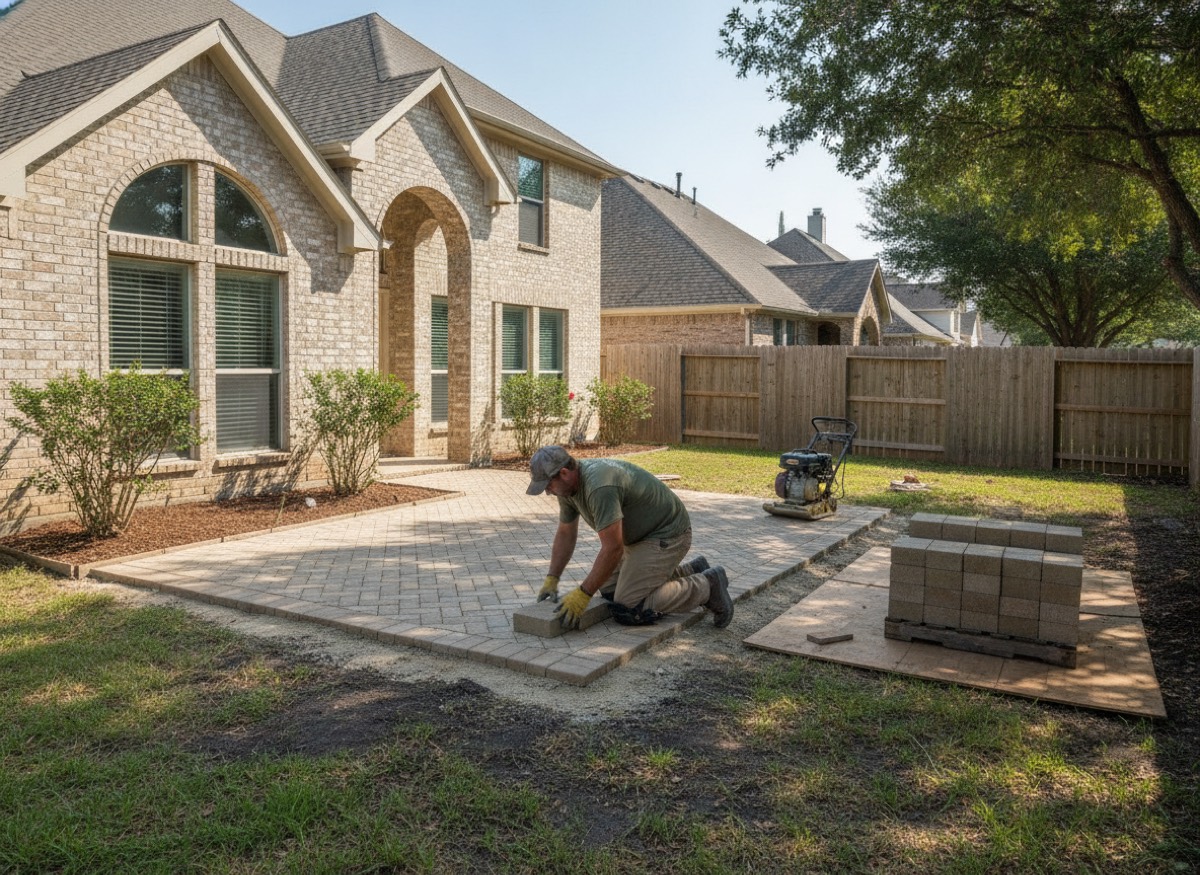
Why paver patios sink, and what stops it
- Depth. Guidance most installers quote is at least 4 inches of compacted crushed stone for a patio, plus about an inch of bedding sand. One company told a homeowner "most companies will do only 2 inches of recycled road concrete, and this is cutting corners."
- Compaction in layers. The stone gets packed with a plate compactor a couple of inches at a time, not dumped and packed once.
- Edges. A restraint along the edge keeps the outside rows from creeping out into the lawn.
- Water. The patio slopes away from the house, and downspouts don't empty onto it.
- Clay. Don't let anyone set sand straight on clay: "those pavers will sink and wobble the first time it rains."
Price, plainly
Nobody can give you one honest number. Texas homeowners have reported numbers like these:
- A DFW homeowner on expansive clay was quoted about $14.44 a square foot for a paver patio.
- A San Antonio homeowner got quotes "anywhere from 15 to 30 bucks a foot depending on the stone and how much base work they actually planned to do."
- Houston installers are quoted at $8 to $12 a square foot, and Austin at $10 to $25.
What moves the number: the paver (concrete pavers cost less than travertine or flagstone), base depth, how far the gravel has to be hauled, steps or curves, and tearing out an old slab. Ask for a written quote that lists base depth, edging, joint sand, haul-off and grading, so the bill can't grow at the end.
Keeping new pavers from turning white
- Joint sand (polymeric sand) goes on dry pavers, gets blown off the surface, and is misted, not soaked.
- Sealer goes on only when the pavers are completely dry, never with rain due.
- A white bloom in the first months can be efflorescence from the pavers themselves. It fades with weather and can be cleaned, and it's worse where water pools.
Weeds and ants in the joints
"Everyone we know with pavers complains constantly about weeds and shifting." Weeds mostly grow from seeds that land in dirt caught in the joints, not from below. Full joints of hardened polymeric sand, swept and topped up when they wear down, keep most of them out. Ants nest where the bedding sand is loose and fine. A well-compacted base gives them less to work with.
Getting it fixed if something settles
Ask what happens if a section sinks in the first year, and get the answer in writing. "Now is not responding by phone or email" is how most warranty stories end. Keep the last payment until the job's finished and the area's cleaned up.
Pavers or a concrete patio?
Concrete usually costs less up front, and "it will eventually crack." Pavers cost more, but one cracked or sunken paver can be lifted and replaced. If you'd rather never pull a weed, look at stamped concrete. Read the side-by-side for North Texas clay: Pavers vs Concrete on North Texas Clay.
Building a patio in Allen
A lot of Allen homes are 1990s and 2000s brick houses on small lots with a cedar privacy fence, often with a pool in back. Travertine around pools and Oklahoma flagstone for walkways come up again and again in DFW reviews. The clay here holds water and moves, so a patio needs to shed water away from the slab and the fence line. Trucks and pallets on a soft lawn leave ruts: ask for plywood or mats and for pallets to be stacked at the end of each day "so they don't kill the grass."
What happens after you call
- Call (469) 283-6279, press 1, enter your zip, and you're connected with a local pro.
- They measure, check how the yard drains, and ask what the patio is for.
- You get a written quote with base depth, edging, sand, haul-off and grading listed.
- Excavation, base in compacted layers, bedding sand, pavers, edge restraint, joint sand.
- Walk the patio with them before the last payment.
Where this applies
Allen, Dallas, Plano, McKinney, and the rest of our service areas.
Questions people ask
Is this something that I should be concerned about with a patio that's still less than 1 year old?
Hairline cracks in one paver or joints opening a little are common after the first year. Pavers that dip, rock or slope toward the grass point to the base, and that's worth having looked at.
Why do pavers do this after a year of being installed?
Usually the joints have opened as the base settled or the joint sand wore down. If pavers are sinking, the base was too thin, wasn't compacted in layers, or water is getting underneath.
Does $10k sound right for a paver patio?
It depends on the size, the paver and the base work. Texas homeowners report roughly $8 to $30 a square foot. Divide your quote by the square footage and check that base depth, edging and haul-off are listed.
Why is there a haze when I put down poly sand?
The sand's binder sets on the surface when it isn't fully swept and blown off before it's watered. Hot water and a scrub usually take it off.
How do you prepare the ground for patio stones?
Dig out the soil, lay crushed stone and compact it in layers to at least 4 inches, add about an inch of bedding sand, set the pavers, then lock the edges and fill the joints.
Concrete vs paver patio?
Concrete costs less up front and will crack eventually. Pavers cost more and can be repaired one piece at a time. On clay, either one lives or dies by what's under it.
Find out what's going under your patio before anyone digs
Call (469) 283-6279 and we'll connect you with a paver patio pro serving Allen.